What Is GEO? A Complete Guide to AI Search Optimization
 Written by Villion30 min read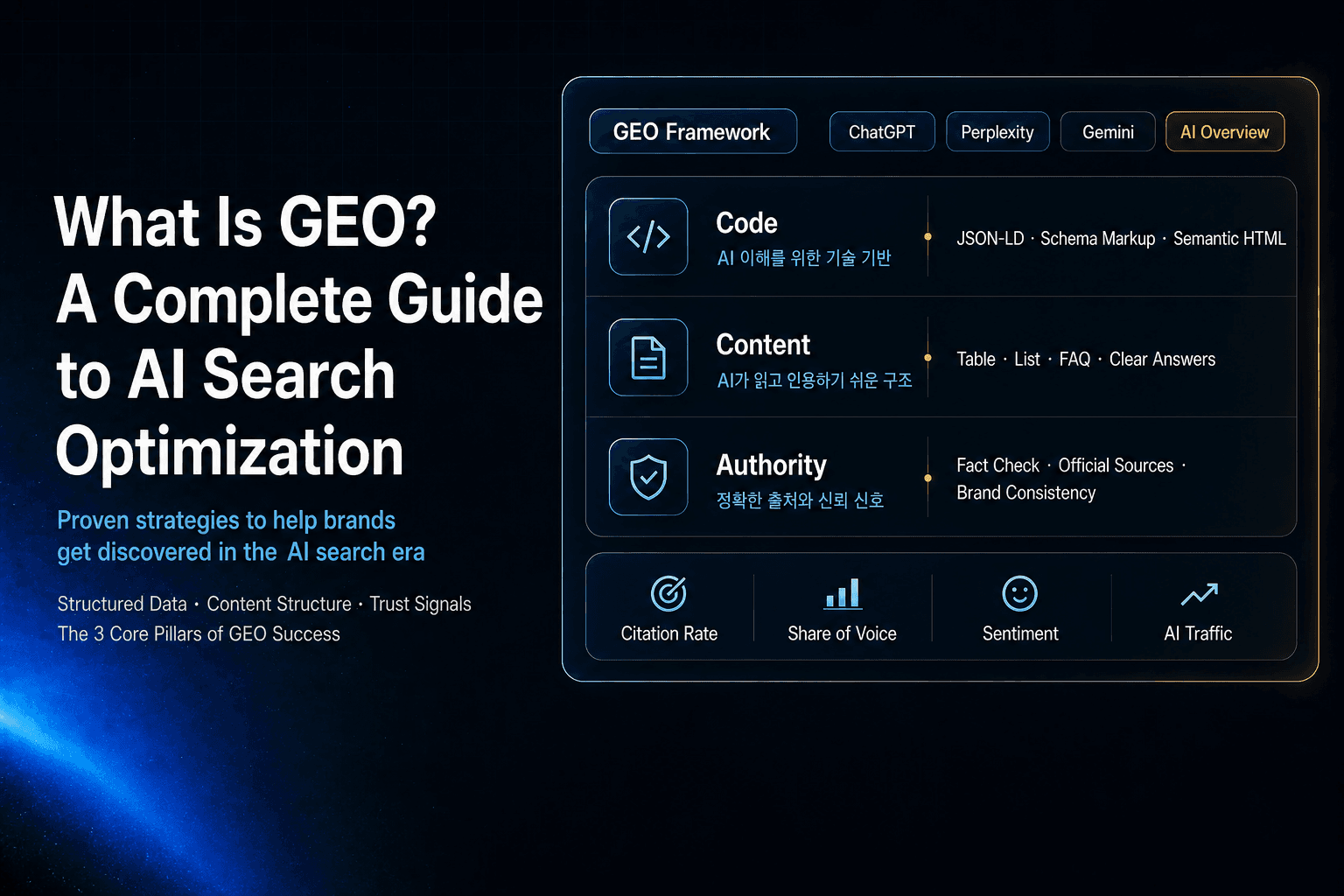
Key takeaways
GEO is the strategy of designing your site, content and metadata so that generative AI search engines (ChatGPT, Perplexity, Gemini, Claude, Google AI Overview, Naver AI Summary, and others) cite and recommend your brand and product as evidence when they answer a user question. Where SEO optimized for SERP rank, GEO optimizes for the inside of the AI answer. It runs on three pillars - Code, Content, Authority and is measured with four KPIs: Citation Rate, Share of Voice, Sentiment, and Downstream Impact. From 2026 on, an Agentic Commerce layer (like Google UCP) sits on top of GEO, making GEO the only doorway into an AI-driven purchase funnel.
Why GEO matters now
Twenty years of digital marketing assumed a linear funnel: search → click → landing → conversion. Through 2024 and 2025, the first step broke. AI now offers the answer above the search results, and users get the information they need without ever clicking a blue link.
Metric | Description | Source |
|---|---|---|
58.5% | Share of U.S. Google searches that are zero-click (EU 59.7%) | SparkToro · Datos, 2024 Zero-Click Study |
800M+ | ChatGPT weekly active users | OpenAI DevDay, Oct 2025 |
UCP | Google's Agentic Commerce standard unveiled (NRF Jan 2026) | Google Blog, 2026 |
From a brand's perspective, three structural shifts are happening at once.
Search behavior is splitting: informational queries are moving to AI answers while transactional queries still flow through SERPs and apps. The research-stage brand touchpoint is moving from SEO into GEO.
The consideration set is shrinking: AI recommends only 2–5 brands at a time. Sitting at #10–#20 in the SERP is a dead zone. 'Near-rank' strategies no longer work.
Agentic Commerce is rising: Google announced the Universal Commerce Protocol (UCP) at NRF in January 2026, and Amazon is building its own agent ecosystem with Rufus, Alexa+ and Buy for Me. GEO is now the entry point to a funnel where AI executes the purchase. Our UCP explainer covers it in detail.
Where GEO works: the AI surfaces
GEO doesn't target one AI; it targets a set of AI surfaces. Each surface has a different crawler, citation UI and evidence style, so priorities shift between them. The surfaces with the most material impact for Korean brands are below.
Surface | Context | Citation style |
|---|---|---|
ChatGPT (OpenAI) | Search-style answers (ChatGPT Search) + business/research chat | Inline URL citations via web search; a Sources list |
Perplexity | An answer-engine specialist with a source-centric UI | Inline footnotes plus a Sources card |
Google AI Overview / AI Mode | AI summary at the top of the SERP + AI Mode conversation | Summary plus Learn More links; UCP enables shopping conversion |
Google Gemini | Gemini app, Workspace, Android | Citation links when Grounding with Google Search is used |
Microsoft Copilot | Edge, Windows, M365 — runs on the Bing index | Numbered footnote citations |
Anthropic Claude | Chat + Artifacts + work-style research | Sources block when the web tool is used |
Naver AI Summary (AI Briefing) | AI summary at the top of Naver search — the default Korean entry point | Body content + linked Naver knowledge cards and snippets |
Surfaces differ a lot, but the foundation is the same — JSON-LD structured data, a clear answer structure, and official sources. Get those three right and your brand becomes 'readable' on every surface.
GEO vs SEO: a structural comparison
The misconception that 'GEO replaces SEO' is common. In reality, SEO is a prerequisite for GEO; the two diverge on a shared infrastructure. The structural differences:
Axis | SEO | GEO |
|---|---|---|
Target UI | Rank inside the SERP | Citation and recommendation inside AI answers |
Primary metrics | CTR, position, impressions | Citation Rate, Share of Voice, Sentiment |
Core optimization unit | Keywords, backlinks, Core Web Vitals | Fact + Source + Structured Data |
Content pattern | Keyword density and headline optimization | Question H2 + direct answer + evidence table |
Crawlers | Googlebot, Bingbot, Yeti | GPTBot, PerplexityBot, ClaudeBot, Google-Extended |
Conversion path | SERP click → landing → conversion | Recommendation in the AI answer → (UCP / agentic) direct transaction |
Relationship | Foundation for GEO | Layer that sits on top of SEO |
Continue with GEO vs SEO: differences and transition strategy and Why SEO matters more in the GEO era.
GEO's three pillars
GEO is not a magic trick. It's three foundation layers stacking up. Strength in only one of them has limited effect. The brand appears reliably inside AI answers only when all three are above average.
01. Code
Declare what you are in machine-readable form
Organization, Product, Article, FAQPage, BreadcrumbList and HowTo JSON-LD
Consistent Open Graph, Twitter Card and canonical URL
Semantic HTML (section, article, nav, header, footer) and a clean heading hierarchy
Allow AI crawlers via llms.txt, robots.txt and sitemap.xml
Core Web Vitals (LCP/INP/CLS) — directly tied to AI crawler render success
02. Content
A format AI can lift paragraph by paragraph
The 'question H2 + 1–2 sentence direct answer + evidence list' pattern
Answer density — each priority query closed out in a single piece
Structured components: comparison tables, checklists, timelines
Original data, citable statistics, case studies
Multimodal cues: image alt text, table captions, video transcripts
03. Authority
Be the 'safe place to cite' that AI can pick without hallucination risk
Cite primary sources explicitly (government, research, 1st-party data)
Show author profiles and expertise (author schema)
Expose reputation signals via Review and AggregateRating schema
Brand entity consistency (Wikidata, Google Knowledge Graph)
Visible update history — declare dateModified
Measurement: the four GEO KPIs
Managing GEO 'by feel' makes budget decisions indefensible. Read these four metrics weekly and you can reverse-engineer which query or engine has a problem.
Citation Rate
What it measures — Share of N target queries where your brand appears in the answer
Why it matters — The simplest expression of 'do you exist inside the AI answer?'
What to watch — Weekly trend — sharp drops signal content or schema issues
Share of Voice
What it measures — Your mention share vs. competitors on the same query set
Why it matters — Relative market position — basis for budget and partnerships
What to watch — Spread vs top three rivals, gaps by category
Sentiment / Context
What it measures — Sentiment of mentions plus whether the product name is used correctly
Why it matters — Being 'mentioned but distorted' is a net negative
What to watch — Root cause of negative mentions — outdated reviews, stale news
Downstream Impact
What it measures — Conversion, LTV and branded search growth from AI-sourced sessions
Why it matters — The ultimate ROI — does it move revenue and pipeline?
What to watch — GA4 UTM data + branded keyword search volume
Industry-specific applications
GEO's ROI varies by industry. The longer the pre-purchase research phase and the more complex the comparison criteria, the higher the commercial value of an AI citation.
Industry | Fit | Example query | Key lever |
|---|---|---|---|
B2B SaaS | High | 'Zendesk alternatives for a 100-customer support team' | Comparison tables, case studies, pricing JSON-LD + structured G2/Capterra reviews |
E-commerce (beauty / fashion / home) | High | 'hydrating toner for sensitive skin', 'mood lamp for a studio' | Consistent Product/Offer schema + conditional long-tail content + UCP readiness |
Fintech | High | 'corporate card for a Pangyo startup' | Fee/limit/perks comparison tables + links to official regulatory sources |
Education / EdTech | Med-High | 'data-analysis bootcamps for landing a job' | Curriculum HowTo schema + alumni-review AggregateRating |
Healthcare | Medium | 'pre-op care for Gangnam LASIK' | MedicalWebPage + FAQPage schema within medical-ad regulations, visible expert authorship |
Local services | Medium | 'quiet wine bar near Gangnam Station' | LocalBusiness, OpeningHours and geo schema + linked reviews |
A 0–12 month execution roadmap
'Where do I start' is the most common question. The four steps below are the order proven in practice. Following the order matters more than piling on more content.
0–1 month — Diagnosis + foundation layer
Define 30–50 target queries and measure current citation rate and SoV via Villion's free diagnosis
Inject Organization, Product, FAQPage and BreadcrumbList JSON-LD site-wide
Hit zero errors in Rich Results Test
Allow GPTBot, PerplexityBot, ClaudeBot and Google-Extended via llms.txt and robots.txt
1–3 months — Restructure the content layer
Refactor existing posts into the 'question H2 + direct answer + evidence' pattern for each priority query
Publish 3–5 new pieces grounded in original data, case studies and comparison tables
Redesign FAQ data around queries (each FAQ ≥200 chars, with evidence links)
Stand up a weekly dashboard for Citation, SoV, Sentiment and Downstream Impact
3–6 months — Build trust assets
Secure reciprocal citations with authoritative media and partners
Clean up Wikidata and Google Knowledge Graph entities
Apply Schema.org Review consistently beyond Google and Naver
Build a loop to detect and correct moments when 'AI says wrong product info' early
6–12 months — Prepare for Agentic Commerce
Audit Merchant Center feed consistency (UCP onboarding readiness)
Internally review identity linking across loyalty, membership and CRM
Adapt to Naver AI Summary — Korean entity and knowledge-card consistency
Run a half-yearly GEO KPI review and budget reallocation framework
Frequently asked questions
What is GEO?
GEO (Generative Engine Optimization) is the practice of optimizing your website and content so that generative AI search engines — ChatGPT, Perplexity, Gemini, Claude, Google AI Overview — cite and recommend your brand in the right context. Where classical SEO competes for SERP rank, GEO competes for the probability that an AI picks your brand as evidence when it composes an answer. The unit of optimization is not the keyword, but a bundle of fact + source + structured data that can answer a query.
What's the difference between GEO and SEO?
SEO targets SERP rank on Google or Naver and optimizes for keywords, backlinks and Core Web Vitals. GEO targets citation rate and share of voice inside AI answers, and centers on JSON-LD, content structure (tables, lists, FAQs), official sources and brand entity consistency. The two are cumulative, not substitutes — solid SEO is the prerequisite for GEO, and GEO is what keeps your brand visible in the zero-click era.
Why does GEO matter?
First, zero-click search has jumped past 50% of all searches (Similarweb · SparkToro 2025). Second, users are starting to research before purchase on ChatGPT, Perplexity and Gemini instead of Google. Third, if your brand isn't in the AI answer, you lose not just traffic but inclusion in the consideration set. Fourth, Google's UCP (Universal Commerce Protocol), unveiled at NRF January 2026, is launching the Agentic Commerce era — AI executing the purchase itself — and GEO becomes the only gateway the agent reads.
How does GEO work?
Three layers. (1) Code: declare what you are in machine-readable form via Schema.org JSON-LD (Organization/Product/Article/FAQPage/BreadcrumbList/HowTo), and explicitly allow GPTBot, PerplexityBot, ClaudeBot and Google-Extended in robots.txt with an llms.txt site guide. (2) Content: write so AI can lift quotes paragraph by paragraph — 'question H2 + short direct answer + evidence table or list.' (3) Authority: lower hallucination risk through official source links, entity consistency (Wikidata, Google Knowledge Graph), structured reviews and ratings, and visible expert authorship — so AI treats your site as a safe place to cite.
Are GEO and AEO the same thing?
Practically, almost synonyms. GEO leans on getting cited inside generative AI engines like ChatGPT, Perplexity, Gemini and Claude. AEO (Answer Engine Optimization) is the older term from the Google Featured Snippets, Position Zero and Knowledge Panel era, focused on answer-first UIs. Today both terms refer to optimizing across the entire answer-driven search surface. Villion uses GEO for clarity and industry adoption.
How do we start with GEO?
Order matters. (1) Diagnose — measure whether ChatGPT, Perplexity, Gemini and Claude actually cite your brand across 30–50 priority long-tail queries, and how competitors show up. (2) Foundation — inject Organization, Product, BreadcrumbList and FAQPage JSON-LD across every page; drive Rich Results Test errors to zero. (3) Content — for each priority query, build the evidence content AI can lift cleanly (comparison tables, checklists, case studies). (4) Authority — accumulate domain trust through external citations, reviews and expert mentions. Villion's free diagnosis automates steps (1) and (2), so you can see a visible change in the first month.
Which industries get the most out of GEO?
The longer the pre-purchase research phase, the bigger the return. B2B SaaS, fintech, legal, healthcare and education see high commercial value because they're full of comparison, criteria and terminology queries. E-commerce (beauty, fashion, home) has wide opportunity in conditional recommendation queries (for sensitive skin, for a one-room studio, for men in their thirties). High-frequency, low-consideration grocery sees comparatively less commercial impact. If you're not sure, check your audience's research-to-conversion lead time — anything over two days makes GEO valuable.
How do we measure GEO performance?
Four metrics. (1) Citation Rate — share of N target queries where your brand appears in the answer. (2) Share of Voice — your mention share versus competitors on the same query set. (3) Sentiment/Context — whether mentions are positive, neutral or negative, and whether the product name is used correctly. (4) Downstream Impact — conversion rate, LTV and branded search growth from AI-sourced sessions. Villion aggregates these four weekly across ChatGPT, Perplexity, Gemini, Claude and Naver's AI summary.
How does your brand show up in AI answers?
Get a brand audit- 가이드