Is SEO Over? Why SEO Matters More in the GEO Era
 Written by Villion9 min read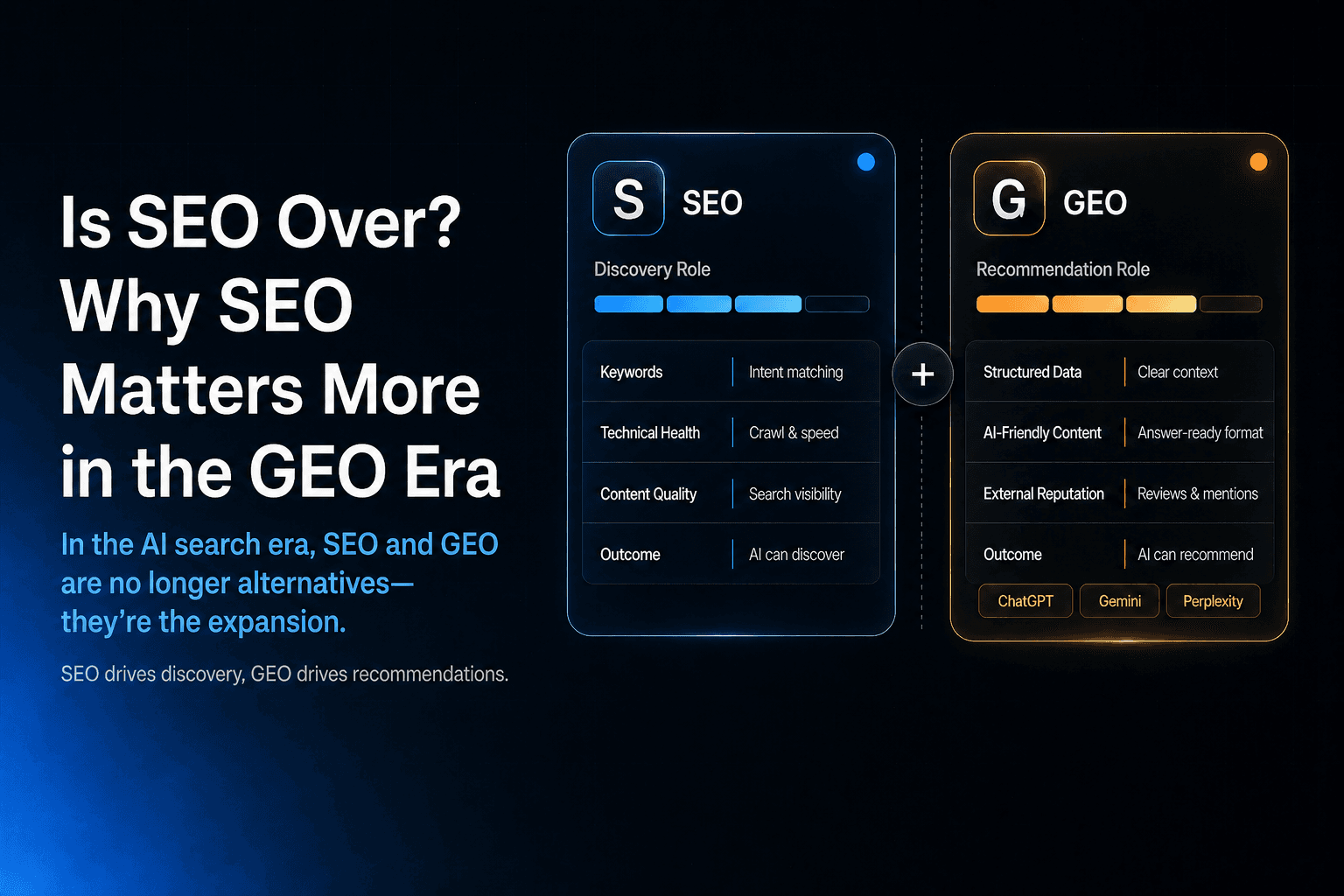
Key takeaways
Without SEO, AI never discovers your brand.
Without GEO, AI never recommends your brand.
ChatGPT, Gemini and Perplexity each lean on web content in different ways.
SEO and GEO are not substitutes — they need to be managed as one flow.
Where AI gets its information
"Recommend the best CRM." Two years ago you would have compared ten Google results yourself. Today ChatGPT picks three for you. Consumers no longer browse search results — AI chooses on their behalf.
But AI doesn't invent answers out of thin air. ChatGPT, Gemini and Perplexity all search the web when they generate a response.
The pattern is clear.
What AI references is ultimately web content. AI cannot recommend a brand it cannot find on the web.
If SEO collapses, GEO collapses with it.
Insights by platform
ChatGPT (The clearest explainer wins)
Generates answers via integrated web search. Educational content with clear definitions and structure tends to get cited; marketing-heavy landing pages almost never do.
The SEO role · High-quality content that ranks is the prerequisite for AI citation
Gemini (Win on Google, win on Gemini)
Pulls directly from Google search data. Brands that rank well in Google are overwhelmingly more likely to be recommended in Gemini, with a clear preference for recently updated content.
The SEO role · Classical SEO is the strongest lever for Gemini recommendations
Perplexity (Others mentioning you is what wins)
Cites a source URL in every answer. Third-party review sites (G2, Capterra) and industry media get cited overwhelmingly more often than first-party brand sites.
The SEO role · Off-site SEO (reviews, contributed media) determines Perplexity presence
SEO vs GEO: expansion, not replacement
SEO and GEO are not rivals. SEO makes AI "discover" your brand; GEO makes AI "recommend" it.
Dimension | SEO | GEO |
|---|---|---|
Role | Helps AI find you | Helps AI recommend you |
Core elements | Keywords, backlinks, page speed | Structured data, clear definitions, external reputation |
Content tone | Click-driving (CTR-optimized) | Explanatory and educational (AI-comprehension-optimized) |
What you compete for | 10 links on page one | The 3–5 brands AI actually picks |
External factors | Backlinks | Third-party reviews, media mentions, industry citations |
Reach | Google, Naver, Bing | ChatGPT, Gemini, Perplexity + classical search |
Why running them separately is inefficient
In most companies, SEO and GEO are run as separate projects. The SEO team tracks keyword ranks, the marketing team manually checks AI answers, and the engineering team manages structured data on its own.
The result: the data is fragmented, and you can't tell which work actually moved AI recommendations.
SEO improvements: Site structure, meta tags and content quality optimization
GEO tracking: Per-platform brand mention rate, sentiment and share-of-voice monitoring
Unified analysis: See SEO changes → AI recommendation shifts in one flow
Villion manages SEO diagnostics and GEO analysis on one platform. You can see right away — on the same dashboard — how improving the site's technical health moves your AI recommendation metrics.
Frequently asked questions
If we do SEO well, does GEO take care of itself?
Only partly. Strong SEO raises the odds that AI even discovers your content, but for AI to cite it in an answer you still need GEO-specific work — structured data, AI-friendly content structure and outside reputation.
Can we do only GEO and skip SEO?
No. ChatGPT, Gemini and Perplexity all generate answers by searching the web. Gemini in particular leans directly on Google search results. AI can't recommend a brand it can't find on the web.
Doesn't doing SEO and GEO at the same time double the cost?
No — SEO and GEO overlap heavily. High-quality content, technical optimization and site-structure work benefit both. An integrated solution like Villion lets you manage SEO and GEO in one workflow, which is actually more efficient than running them in parallel.
If AI search keeps growing, does SEO eventually disappear?
It changes shape; it doesn't disappear. AI search engines still source from the web. The optimization goal is expanding from 'rank #1' to 'be cited in the AI answer', and the discipline that responds to that shift is GEO.
How does your brand show up in AI answers?
Get a brand audit- Insights