The Zero-Click Era: Five Conditions That Get Your Brand Cited by AI
 Written by Villion18 min read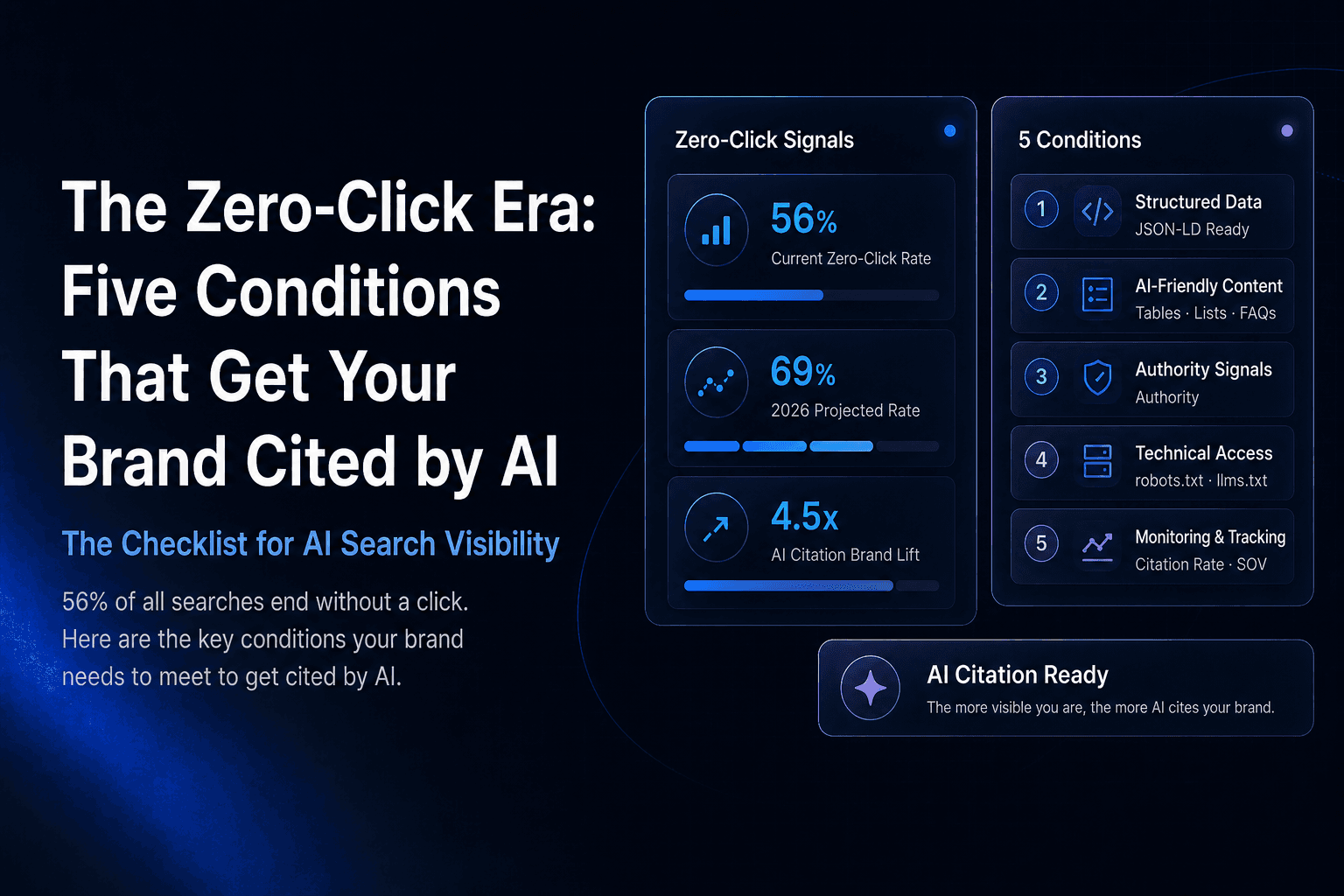
Key data on the zero-click era
Figure | Description |
|---|---|
58.5% | Share of U.S. Google searches that are zero-click (EU 59.7% · SparkToro, Datos, 2024) |
80%+ | Major search engines with an AI answer UI (Google AI Overview, ChatGPT Search, Perplexity, Gemini, Claude) |
2–5 | Brands shown per AI answer (vs 10–20 in a classic SERP) |
Why zero-click is accelerating now
Zero-click didn't appear overnight. Years of accumulated shifts in user behavior met the 2024–2025 wave of AI answer UIs, and the dam broke. Four forces drive it.
Answer-first UIs became the default: Google AI Overview, ChatGPT Search, Perplexity, Gemini and Claude all lead with the answer. Blue links are now demoted to a “Sources” section underneath.
Mobile, voice and devices expanded: Smartwatches, AirPods, car speakers and other narrow- or no-screen environments make clicking links awkward. Having AI speak the answer back is now the natural UX.
Search intent is being re-bucketed: Informational queries (“what is X”, “how do I”) go to AI answers, while transactional queries (“buy”, “check out”, “book”) go to apps and shopping SERPs. The zero-click rate in the informational bucket has jumped especially hard.
AI crawlers are running massive training cycles: GPTBot, PerplexityBot, ClaudeBot and Google-Extended consume and summarize content at scale, growing a knowledge base from which answers can be synthesized without visiting the source page.
Three structural shifts for brands
① The traffic mix moves
Inbound traffic from informational queries, blogs, guides, definition pages - drops sharply. Its place is taken by 'brand name + intent (buy / review)' queries and direct referrals from AI answers. In your GA4 acquisition reports, AI sources (chat.openai.com, perplexity.ai, gemini.google.com, claude.ai) settle in as their own channel.
② The consideration set shrinks
The candidate pool is no longer the 10–20 results on page one but the 2–5 brands that appear in a single AI answer. 'Sneaking in near the top' is over; the gap between brands in the top 2–5 and those left out widens exponentially.
③ Brand info quality maps directly to revenue
When AI says something wrong, outdated price, discontinued SKU, incorrect spec, users walk away and search for a substitute. 'How AI describes you' becomes your brand experience. Information consistency turns into a core marketing KPI.
Five conditions to get cited by AI
01. Structured data (JSON-LD)
AI search engines reach for structured data first to understand what a page means. Without JSON-LD, AI struggles to interpret the information accurately.
Checklist
Organization schema applied
Product/Service schema applied
FAQ schema applied
BreadcrumbList schema applied
Passes Google's Rich Results Test
02. AI-friendly content structure
AI understands and quotes structured information better than long prose. Tables, lists and FAQs are the easiest formats for AI to lift into an answer.
Checklist
Key information laid out as a table
Step-by-step processes written as numbered lists
Common questions delivered in FAQ format
Each page has a top-of-page key takeaway
Comparative information is presented as comparison tables
03. Trust signals (authority)
To avoid hallucination, AI favors sources it can trust. The higher your brand's credibility, the higher your citation odds.
Checklist
Information lives on the official brand site
Data and statistics cite their sources
Expert profiles and author information are visible
Brand info (NAP) stays consistent across the web
External certifications or partnerships are documented
04. Technical accessibility
If AI crawlers can't reach your site, even your best content can't be cited. The environment has to be technically easy for AI to consume.
Checklist
robots.txt allows AI crawlers (GPTBot, PerplexityBot, and others)
An llms.txt file is published (a site guide for AI crawlers)
sitemap.xml is kept current
Page load speed is tuned (Core Web Vitals)
Semantic HTML is used (correct heading structure)
05. Continuous monitoring and improvement
GEO isn't one-and-done — it's an ongoing process. The AI search landscape shifts quickly, so regular monitoring and iteration are mandatory.
Checklist
Citation rate is tracked on a regular cadence
Share of voice inside AI answers is monitored
AI-sourced traffic is analyzed as a distinct channel
Competitors' AI citation status is known
Content is iterated based on what the data shows
A one-page checklist
Fourteen items, ordered by priority across the five conditions above. The recommended cadence is: items 1–4 this week, 5–9 this month, 10–14 next quarter.
This week (foundation)
☐ 1. Explicitly allow GPTBot, PerplexityBot, ClaudeBot and Google-Extended in robots.txt
☐ 2. Publish a first-pass llms.txt — flagship pages, glossary definitions, brand description
☐ 3. Inject Organization and BreadcrumbList JSON-LD site-wide
☐ 4. Run Google Rich Results Test on five key URLs zero errors
This month (content and measurement)
☐ 5. Define 30–50 priority queries and map competitor coverage
☐ 6. Build a weekly citation rate + share-of-voice dashboard
☐ 7. Apply 'question H2 + direct answer + evidence table' to the top 10 pages
☐ 8. Surface FAQs via FAQPage JSON-LD
☐ 9. Apply Product / Offer / Review / AggregateRating structures (e-commerce)
Next quarter (authority and agentic readiness)
☐ 10. Build out expert author profiles and an official source-citation system
☐ 11. Clean up entities in Wikidata and Google's Knowledge Graph
☐ 12. Measure conversion and LTV for AI-sourced sessions as a separate GA4 custom channel
☐ 13. Audit Merchant Center feed consistency (in preparation for UCP)
☐ 14. Design a detection-and-correction loop for when AI says something wrong about you
Frequently asked questions
What is a zero-click search?
A zero-click search is one where the user gets the information they need from the results page without clicking any link. As AI search engines generate the answer directly, users don't need to visit a site to get an answer. According to the SparkToro and Datos 2024 Zero-Click Study, 58.5% of U.S. Google searches and 59.7% in the EU end without a single click.
Is SEO meaningless in the zero-click era?
SEO isn't meaningless, it just isn't enough on its own. AI search engines still source from web content, so the most effective approach is to layer a GEO strategy on top of your existing SEO foundation.
What does being cited by AI actually deliver?
A brand cited in an AI answer earns guaranteed entry into the consideration set. When the citation is in the form of a recommendation, user trust jumps and it contributes directly to conversion. Industry observation puts AI-answer brand exposure at the top of the funnel as roughly equivalent to, or even stronger than a top SERP placement. Share of voice inside AI answers also has a measurable effect on brand awareness and long-term LTV.
As zero-click grows, what happens to branded search?
It becomes more important. Once AI answers the informational query, all the user has left is the question 'which brand is right' and they type the brand name directly. Informational query traffic falls, but branded keyword volume rises. The ratio of branded versus generic keyword traffic in GA4 and Search Console becomes a leading indicator of GEO success.
Aren't AI crawlers (GPTBot and the like) a security risk to allow?
Login, checkout and personal-info pages should be blocked of course, but blocking public marketing, product and blog pages amounts to 'shutting the door on AI ever knowing your brand.' The standard recommendation is to Disallow only sensitive paths (/admin, /account, /checkout) and to Allow GPTBot, PerplexityBot, ClaudeBot and Google-Extended for everything else. An llms.txt that tells the crawler which pages to read first raises crawl efficiency further.
Do reviews and ratings still matter in a zero-click world?
They matter more. AI weighs reviews, ratings and AggregateRating heavily when recommending a 'trustworthy choice.' The challenge is keeping reviews consistent across Naver/Google/Kakao Maps, your own store, marketplaces and communities. Make reviews machine-readable via Schema.org Review/AggregateRating, and attach official responses to negative reviews so the 'brand's voice' gets cited alongside them.
How does your brand show up in AI answers?
Get a brand audit- Insights