Why Korean E-commerce Brands Vanish in AI Search and How to Fix It
 Written by Villion13 min read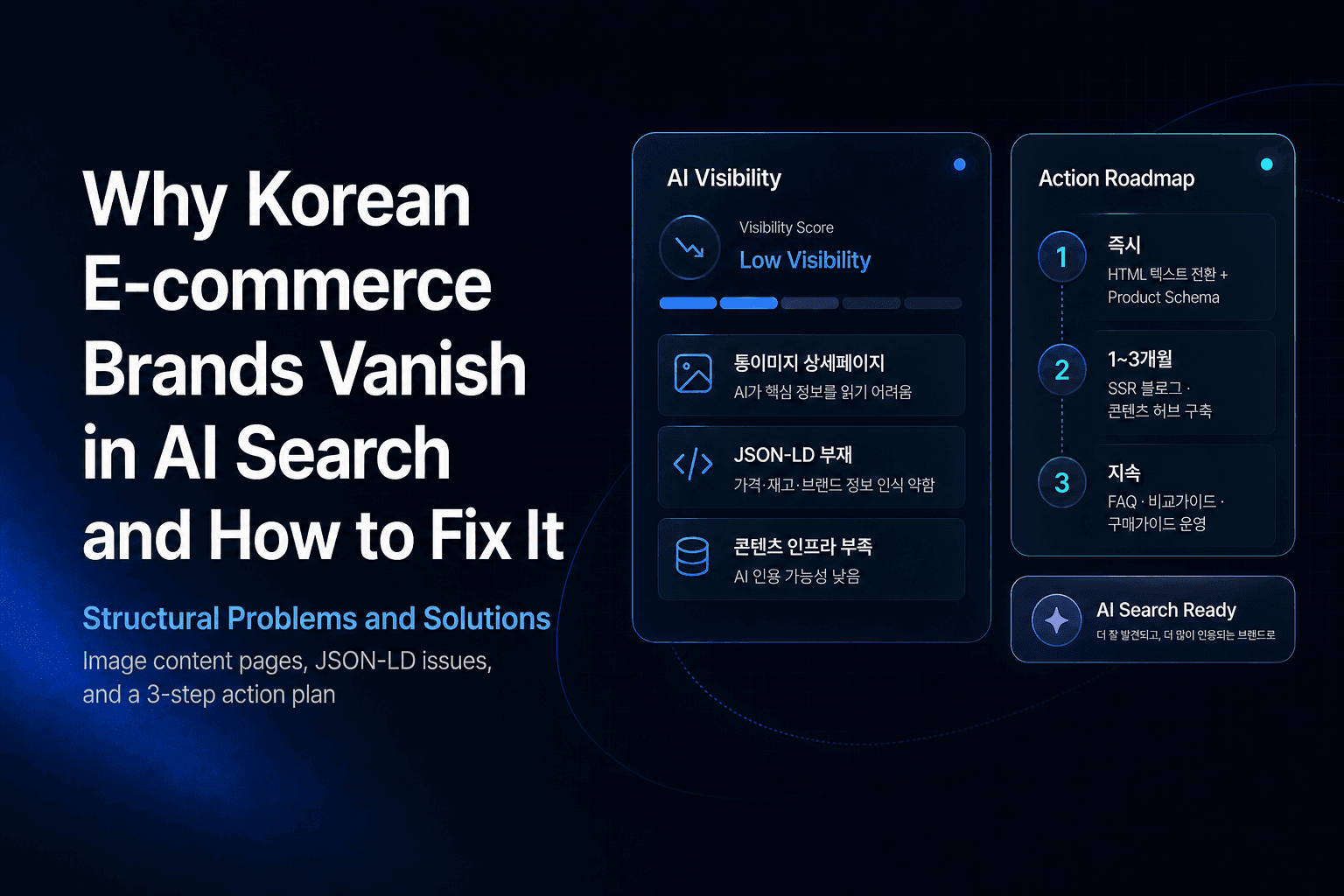
Why you're invisible: two structural problems
According to Semrush's AI Overviews Study 2025 (10M+ keywords analyzed), Google AI Overview appeared on as many as 24.61% of queries in July 2025. SparkToro and Datos' 2024 Zero-Click Study found that 58.5% of U.S. Google searches (59.7% in the EU) end without a single click. In an environment where AI delivers the answer directly, sites that AI can't read get squeezed out of the conversation.
1. Single-image product detail pages
Korean e-commerce has a deeply rooted convention of laying out product detail pages as one long image rather than HTML text. It looks clean visually, but search engines can't see heading structure and there's no text for structured data to map onto.
Critically, AI crawlers like GPTBot, ClaudeBot and PerplexityBot can't extract text from images. No matter how detailed your product description is, from AI's perspective the page is effectively blank.
2. Missing structured data (JSON-LD)
AI Overview, Perplexity and ChatGPT search lean on the Product schema first to understand product information. If price, availability, rating and brand entity aren't declared in JSON-LD, AI has to guess by parsing free text — and citation odds drop sharply.
One caveat: structured data is necessary but not sufficient. Schema alone doesn't guarantee AI citations. Text content quality and brand authority still have to be there.
A three-step playbook
01. Build the technical foundation immediately (Now – 2 weeks)
Convert single-image product detail pages into HTML text. Mark up the core information (product name, price, specs, review summary) with semantic tags (<h2>, <p>, <ul>) and ship Product, BreadcrumbList and Organization JSON-LD.
Action items:
Single-image → HTML text conversion (prioritize core product info)
Add Product schema (name, price, availability, review)
Verify robots.txt allows GPTBot, PerplexityBot and ClaudeBot
Validate with Google Rich Results Test
Add an llms.txt file (a site guide for AI crawlers)
02. Spin out a dedicated content surface (1 – 3 months)
Build a blog.brandname.com subdomain on an SSR framework like Next.js. A subdirectory is stronger for SEO in theory, but hosted commerce platforms usually make it technically impossible — so a subdomain is the pragmatic best. Compensate by linking from your main site's nav and footer to the blog, and use the same Organization schema on both so search engines see one brand entity.
Action items:
Stand up an SSR-based blog subdomain (Next.js recommended)
Internal links from main nav and footer into the blog
Use identical Organization schema on both properties
Either merge or cross-reference the sitemap.xml files
Register the subdomain separately in Search Console
03. Design content as a brand asset (3+ months, ongoing)
Bulk-publishing AI-generated content on hidden URLs is the pattern Google's Core and Helpful Content Updates explicitly target. The sustainable approach is to publish, inside your real site navigation, pieces that answer the questions customers actually ask. Depth is what matters — AI pulls from a single well-structured piece, not from duplicate pages.
Action items:
Mine real customer questions from Search Console data
Write category-level comparison and buying guides
Apply FAQ schema to each piece (raises citation odds)
Avoid AI content spam — one deep article beats ten shallow ones
Use branded query analysis to course-correct over time
Execution summary
When | Action | Expected outcome |
|---|---|---|
Now | Convert single-image pages to HTML + apply JSON-LD | AI can read your content |
1 month | Stand up a subdomain blog | A surface for publishing content |
1–3 months | Publish content from search data | Build topical authority |
3+ months | Analyze branded queries → adjust direction | A data-driven flywheel |
In the AI search era, brand competitiveness is decided not by ad budget but by depth of content assets. The starting point is figuring out what customers are actually searching for.
Frequently asked questions
Isn't it expensive to migrate single-image product pages to HTML?
You don't have to migrate every SKU at once. Start with the top-revenue 20% of products or with new launches, and roll it out in waves. Even marking up just the core information (product name, price, specs, review summary) with HTML text and Schema.org Product/Offer JSON-LD is enough for AI crawlers to understand the page. Keep the visual elements as images, and layer text information on top with semantic tags — that's the pragmatic path.
Subdomain vs subdirectory — which is better for SEO and GEO?
In theory, a subdirectory (brand.com/blog) shares domain authority and is stronger for SEO. In practice, hosted commerce platforms like Cafe24, Imweb and NHN Commerce often won't let you add SSR-rendered content under a subdirectory. In that case a subdomain like blog.brand.com is the realistic fallback. Keep authority unified by using the same Organization schema on both, cross-link aggressively, and either merge or cross-reference sitemap.xml.
Will publishing a flood of AI-generated content quickly increase visibility?
It can look that way in the short term, but it loses in the long term. Both Google's Helpful Content Update and AI search engines identify mass-produced filler content. A single deep answer page is far more citable than ten superficial ones. Before publishing, use Search Console data to find the questions customers actually ask, and write each piece to answer one of them end-to-end.
If I allow AI crawlers in robots.txt, won't my content be stolen?
Public marketing, product and blog content is already accessible through other channels (search engines, social, scrapers). Blocking AI crawlers cuts off the most powerful new channel for distributing your brand. The standard recommendation is to Disallow sensitive paths (/admin, /account, /checkout, and the like) but explicitly Allow GPTBot, PerplexityBot, ClaudeBot and Google-Extended for public content.
How quickly do GEO improvements show up?
Structured data and semantic markup typically start showing impact within one to two weeks as AI crawlers re-index. Citation rate and share of voice need cumulative content effects, so meaningful movement usually appears around the two-to-three-month mark. The metrics to watch from day one are the frequency of brand mentions inside AI answers and the change in branded search volume.
How does your brand show up in AI answers?
Get a brand audit- Strategy